
Focusrite Scarlett Solo 4th Gen vs Audient EVO 4
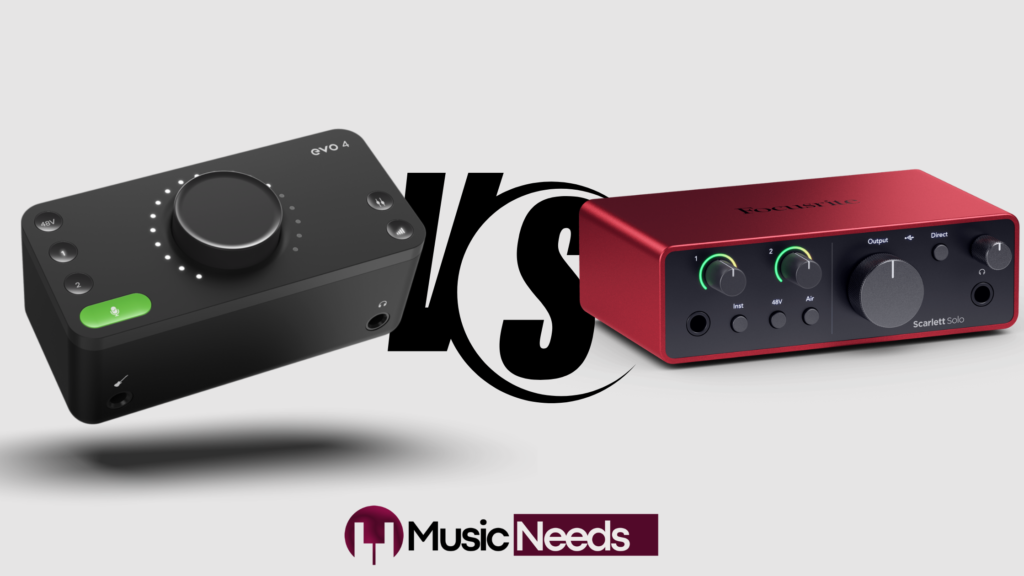
Choosing your first audio interface can feel overwhelming. With so many options available, two models consistently stand out in the entry-level market: the Focusrite Scarlett Solo 4th Gen and the Audient EVO 4.
Both are compact USB audio interfaces capable of producing professional-quality recordings. Both are popular among musicians, podcasters, streamers, and home studio owners. But while they appear similar on paper, they take very different approaches to recording.
At Music Needs, we don’t judge equipment purely by specifications. Instead, we ask a simple question:
If we were spending our own money, which one would we buy?
After comparing their sound quality, build quality, features, reliability, long-term ownership, and value for money, here’s our verdict.
Table of Contents
Focusrite Scarlett Solo 4th Gen Overview
The Scarlett Solo has been one of the world’s best-selling audio interfaces for years, and the 4th Generation is its biggest upgrade yet.
Focusrite redesigned the microphone preamp, improved the converters, upgraded the headphone amplifier, and introduced features previously found on more expensive interfaces.
New additions include:
- Air Presence Mode
- Harmonic Drive Air Mode
- Dynamic Gain Halos
- Loopback recording
- 120 dB Dynamic Range
- Improved headphone output
Although it’s still designed for solo creators, the Scarlett Solo now feels much more like a professional recording interface than an entry-level device.
It is ideal for:
- Singers
- Beat producers
- Guitarists
- Voice-over artists
- Solo musicians
- Streamers
Audient EVO 4 Overview
The Audient EVO 4 takes a different approach.
Instead of focusing on analogue-style features, Audient prioritises ease of use.
Its biggest feature is Smartgain, which automatically sets microphone gain levels for you.
The EVO 4 also includes two microphone preamps, making it possible to record two microphones simultaneously.
This makes it especially attractive for:
- Podcast creators
- Interviews
- Duets
- Acoustic performances
- YouTubers
- Content creators
Specifications Comparison
| Feature | Focusrite Scarlett Solo 4th Gen | Audient EVO 4 |
|---|---|---|
| Mic Preamps | 1 | 2 |
| Instrument Input | 1 | 1 |
| Phantom Power | Yes | Yes |
| USB-C | Yes | Yes |
| Sample Rate | 24-bit / 192 kHz | 24-bit / 96 kHz |
| Air Mode | Yes (2 Modes) | No |
| Smartgain | No | Yes |
| Loopback | Yes | Yes |
| Dynamic Range | 120 dB | 113 dB |
| Headphone Amplifier | Improved | Good |
While recording at 192 kHz looks impressive on paper, most users recording music, podcasts, or voice-overs will not hear an audible difference compared to 96 kHz. What matters more is converter quality, microphone preamps, and overall workflow.
Sound Quality
This is where the comparison becomes surprisingly close.
Both interfaces produce clean, detailed recordings with very low background noise.
However, they have slightly different personalities.
Focusrite Scarlett Solo 4th Gen
The Scarlett sounds clean and open.
The new Air modes provide additional flexibility.
Presence Mode adds extra clarity and brightness to vocals.
Harmonic Drive introduces subtle analogue-style saturation, giving recordings a slightly richer character.
Combined with the improved converters, the Scarlett sounds more refined than previous generations.
Audient EVO 4
The EVO 4 aims for transparency.
Its microphone preamps capture exactly what your microphone hears without adding noticeable colour.
If you prefer a neutral recording that you can shape later during mixing, the EVO performs exceptionally well.
Winner
Focusrite Scarlett Solo 4th Gen
The difference is not dramatic, but the upgraded converters and Air modes give the Scarlett a slight advantage.
Microphone Preamps
Both manufacturers build excellent microphone preamps.
The Scarlett offers:
- Lower noise
- More gain than older generations
- Air Presence
- Harmonic Drive
The EVO offers:
- Two microphone preamps
- Neutral sound
- Smartgain automatic setup
If recording quality is your only concern, both perform extremely well.
If flexibility matters, the EVO’s second microphone input is difficult to ignore.
Build Quality
Focusrite Scarlett Solo
This is one of the strongest points of the Scarlett.
The aluminium chassis feels exceptionally solid.
Knobs feel premium.
The interface easily survives regular transport between studios, rehearsal spaces and live gigs.
Audient EVO 4
The EVO uses a lightweight plastic enclosure.
Build quality is still very good, but it doesn’t feel as rugged as the Scarlett.
Winner
Focusrite Scarlett Solo 4th Gen
Recording Features
This category depends entirely on how you record.
Scarlett Solo
Perfect for:
- Recording vocals
- Guitar
- Bass
- Voice-over
- Beat production
The addition of Loopback makes streaming and recording computer audio much easier than previous Scarlett models.
EVO 4
The EVO allows:
- Two microphones simultaneously
- Podcasts
- Interviews
- Stereo acoustic recordings
- Smartgain automatic setup
For anyone recording more than one microphone, the EVO is considerably more versatile.
Winner
Audient EVO 4
Ease of Use
The Scarlett uses traditional gain knobs and dedicated controls.
Everything feels familiar.
The EVO takes a modern approach with one multifunction encoder and Smartgain.
Beginners often achieve good recording levels within seconds.
Winner
Audient EVO 4
Music Production
Both interfaces work exceptionally well with:
- FL Studio
- Logic Pro
- Ableton Live
- Cubase
- Studio One
- Reaper
- Pro Tools
Latency is excellent on both when configured correctly.
Neither interface will limit your ability to produce professional music.
The Scarlett’s upgraded headphone amplifier does make long mixing sessions slightly more enjoyable.
Winner
Focusrite Scarlett Solo 4th Gen
Podcasting & Streaming
If you record podcasts with guests, interviews or co-hosts, the choice is simple.
The Scarlett Solo only has one microphone preamp.
The EVO 4 has two.
That means you can connect two XLR microphones without buying another interface.
Winner
Audient EVO 4
Driver Stability
Driver quality is often overlooked until something goes wrong.
Focusrite has one of the strongest reputations in the industry.
Its drivers are mature, stable and frequently updated.
Audient drivers are also reliable, but Focusrite has a much longer track record across Windows and macOS.
Winner
Focusrite Scarlett Solo 4th Gen
Value for Money
Both interfaces deliver excellent value.
However, they appeal to different buyers.
Choose the Scarlett if you value:
- Better build quality
- Better converters
- Higher dynamic range
- Excellent drivers
- Air modes
- Premium construction
Choose the EVO if you value:
- Two microphone inputs
- Smartgain
- Recording podcasts
- Recording two people at once
Neither is a poor purchase.
Buying Used
At Music Needs, we specialise in used audio equipment, so here’s what we’d inspect before buying either interface.
Focusrite Scarlett Solo 4th Gen
Check:
- USB-C port
- Gain knobs
- Phantom power
- Air mode operation
- Headphone output
- Original USB cable
- Signs of liquid damage
Expected used condition:
Excellent.
Scarlett interfaces generally have strong resale value.
Audient EVO 4
Check:
- Smartgain operation
- Encoder knob
- USB-C connector
- Headphone output
- Firmware version
- Original accessories
Expected used condition:
Very good.
Replacement parts are less common than Focusrite products.
South African Buying Advice
South African buyers should consider more than just the purchase price.
Also think about:
- Local warranty support
- Replacement parts
- Used market availability
- Resale value
- Local distributors
- Import costs
The Scarlett range is generally easier to find both new and second-hand in South Africa, making it a safer long-term investment if you plan to upgrade later.
Which One Would Music Needs Buy?
This depends entirely on how you record.
Buy the Focusrite Scarlett Solo 4th Gen if:
- You always record alone.
- You produce beats.
- You record vocals.
- You play guitar.
- You value premium build quality.
- You want the best converters in this price range.
- You want industry-leading driver support.
Buy the Audient EVO 4 if:
- You record podcasts.
- You interview guests.
- You need two microphone inputs.
- You want Smartgain.
- You often collaborate with other musicians.
Frequently Asked Questions
Is the Scarlett Solo 4th Gen better than the Audient EVO 4?
For solo recording, yes. It offers better converters, improved dynamic range, premium build quality, excellent drivers and Air modes.
For podcasting or recording two microphones simultaneously, the EVO 4 remains the better option.
Which sounds better?
Both sound excellent.
The Scarlett has a slightly more polished sound thanks to its updated converters and Air modes, but the difference is subtle.
Which is better for beginners?
The EVO 4.
Smartgain makes setting recording levels incredibly simple.
Which is better for FL Studio?
Both perform exceptionally well.
Beat producers may prefer the Scarlett thanks to its improved headphone amplifier and Air modes.
Which has better resale value?
The Scarlett Solo generally holds its value better because of its popularity and widespread availability.
Music Needs Score
| Category | Scarlett Solo 4th Gen | Audient EVO 4 |
|---|---|---|
| Sound Quality | 9.5/10 | 9.4/10 |
| Build Quality | 9.8/10 | 8.8/10 |
| Reliability | 9.7/10 | 9.3/10 |
| Features | 9.2/10 | 9.6/10 |
| Ease of Use | 9.4/10 | 9.7/10 |
| Repairability | 8.8/10 | 8.4/10 |
| Value for Money | 9.5/10 | 9.5/10 |
| Used Market Value | 9.6/10 | 9.2/10 |
| Beginner Friendliness | 9.5/10 | 9.8/10 |
| Professional Use | 9.5/10 | 9.3/10 |
Overall Music Needs Score
Focusrite Scarlett Solo 4th Gen: 9.5/10
Audient EVO 4: 9.4/10
⭐⭐⭐ Music Needs Editor’s Choice
Focusrite Scarlett Solo 4th Gen
The Focusrite Scarlett Solo 4th Gen is our top recommendation for solo musicians, producers, singers, guitarists, and voice-over artists.
Its upgraded microphone preamp, improved converters, dual Air modes, premium metal construction, excellent driver support, and outstanding recording quality make it one of the best entry-level audio interfaces available today. It also offers excellent long-term reliability and strong resale value, making it a smart investment for creators who expect to grow their studio over time.
That said, the Audient EVO 4 remains an outstanding choice for podcasters, interviewers, and anyone who regularly records two microphones. Smartgain is genuinely useful, and having two microphone preamps adds flexibility that the Scarlett Solo simply cannot match.
If Music Needs was spending its own money:
- For solo recording, music production, vocals, guitars, and beat making: Buy the Focusrite Scarlett Solo 4th Gen.
- For podcasting, interviews, or recording two people at the same time: Buy the Audient EVO 4.
Both interfaces are excellent, but for most musicians and home studio owners looking for the best combination of sound quality, build quality, reliability, and long-term value, the Focusrite Scarlett Solo 4th Gen earns our Editor’s Choice award.