
If you’re building a home studio in 2026, one of the biggest decisions you’ll make is choosing the right pair of studio monitors. The truth is, your speakers shape almost every mixing and production decision you make. You can have the best plugins, the fastest computer, and expensive microphones, but if your monitors are lying to you, your mixes will struggle everywhere else.
That’s exactly why 5-inch studio monitors remain one of the most popular choices for bedroom studios, podcast setups, editing rooms, and compact music production spaces. They’re small enough to fit comfortably on a desk, but powerful enough for serious work. For producers making trap, hip hop, amapiano, Afrobeats, R&B, podcasts, or YouTube content, a good pair of 5-inch monitors can completely transform the way you hear music.
At Music Needs, we’ve had many of these monitors come through our studio and store over the years — both brand-new and used. We’ve tested them during real recording sessions, vocal mixing, beat production, and everyday listening. This guide is based on actual experience rather than just manufacturer specifications.
Table of Contents
Why 5-Inch Studio Monitors Are So Popular
There’s a reason why almost every beginner producer eventually ends up searching for a pair of 5-inch monitors. They hit a sweet spot between affordability, sound quality, and practicality. Bigger speakers like 7-inch or 8-inch monitors can produce deeper bass, but they also require larger rooms and better acoustic treatment. In smaller home studios, larger monitors often create muddy bass buildup that makes mixing harder instead of easier.
A 5-inch monitor gives you enough low-end to make accurate production decisions while still working well in tighter spaces. That’s especially important for producers working from bedrooms, apartments, or desk setups. Most home studios simply don’t have enough space for massive monitors. A smaller speaker allows the sound to stay controlled without overwhelming the room.
Another major advantage is listening fatigue. Many compact monitors are designed for long sessions. If you spend hours producing beats, editing vocals, recording podcasts, or mixing YouTube videos, you need monitors that don’t make your ears tired after thirty minutes. Good 5-inch monitors allow you to work comfortably for extended periods while still hearing details clearly.
At Music Needs, we’ve also noticed that many producers upgrade too quickly without first learning their speakers properly. A great producer with smaller monitors often creates better mixes than someone using expensive speakers they don’t fully understand. Learning your monitor’s strengths and weaknesses matters far more than chasing the biggest or most expensive setup.
What Makes a Good Studio Monitor
A lot of beginners assume that louder speakers automatically mean better speakers. That’s rarely true in music production. Studio monitors are designed differently from normal consumer speakers. Their goal is accuracy, not excitement. Good studio monitors tell the truth about your mix, even when that truth hurts.
One of the most important things to look for is frequency response. A balanced monitor allows you to hear bass, mids, and highs evenly without exaggerating one area too much. If your speakers boost bass heavily, you may accidentally mix with too little low-end because the speakers already sound bass-heavy. Then your music sounds thin everywhere else.
Stereo imaging is another huge factor. Good monitors create a clear sense of width and positioning. You should be able to hear exactly where vocals, hi-hats, synths, and instruments sit in the mix. This becomes extremely important for genres like amapiano and trap where space and movement are part of the vibe.
Room compatibility also matters more than people think. Some monitors sound amazing in treated studios but harsh in untreated bedrooms. Others are more forgiving and easier to work with in everyday home environments. That’s why some producers love Yamaha HS5s while others prefer KRKs or JBLs depending on their room and workflow.
A monitor should also match your personality as a creator. Some people want clinical accuracy for engineering work. Others want inspiring speakers that make beatmaking feel exciting. Neither approach is wrong. The best choice depends on how you create music and what keeps you motivated to work consistently.
Yamaha HS5 Review
Why Producers Trust the HS5
The Yamaha HS5 earns the number one position on this list because of its legendary accuracy. These monitors don’t flatter your music. They expose problems clearly and honestly, which is exactly what makes them useful for serious production and mixing work.
At first, some producers actually dislike the HS5 because they expect a huge exciting sound. Instead, the HS5 delivers a clean, controlled, mid-focused sound that forces you to improve your mix decisions. Once producers learn these speakers properly, their mixes usually translate better across cars, headphones, Bluetooth speakers, clubs, and phones.
Vocals especially sound excellent on HS5s. You can hear harsh frequencies, muddy mids, and compression issues very clearly. That makes them extremely popular among vocal engineers and producers who prioritize clarity over hype. They’ve become an industry standard partly because they teach producers how to mix properly instead of masking mistakes.
The downside is the bass response. Compared to KRKs or JBLs, the HS5 can feel lighter in the low-end. Producers making bass-heavy genres sometimes worry about this initially. But surprisingly, many experienced engineers prefer controlled bass because it prevents them from overmixing the low frequencies.
Pros and Cons
| Pros | Cons |
|---|---|
| Extremely accurate mids | Bass can feel limited |
| Excellent vocal clarity | Can sound harsh in untreated rooms |
| Great stereo balance | Less “fun” than bass-heavy monitors |
| Industry-standard reference sound | Requires time to learn properly |
These monitors are best for producers who value precision, clarity, and mixes that translate consistently everywhere.
ADAM Audio T5V Review
Ribbon Tweeter Performance
The ADAM Audio T5V feels premium the moment you hear it. One of the biggest reasons is the ribbon tweeter design. Unlike traditional tweeters, the ribbon tweeter produces an airy, detailed top-end that sounds incredibly smooth and open.
For vocal editing and detailed production work, the T5V is excellent. Reverbs, delays, vocal textures, and subtle effects become easier to hear. Producers working on modern genres with layered synths and atmospheric sounds often fall in love with these speakers immediately.
The stereo image is another standout feature. The monitors create a wide listening field that makes music feel spacious without becoming artificial. During long sessions, the T5V stays enjoyable without sounding too clinical or tiring.
The highs can occasionally feel slightly bright depending on the room and listening volume. Some users may need time adjusting to the extra detail. But for many producers, that detailed top-end is exactly what makes the T5V feel more expensive than its price suggests.
Pros and Cons
| Pros | Cons |
|---|---|
| Premium ribbon tweeter | Highs may feel bright |
| Excellent clarity | Requires decent room positioning |
| Detailed stereo image | Slight learning curve |
| Tight controlled bass | Not as flat as HS5 |
These are fantastic for producers wanting a more high-end listening experience without jumping into extremely expensive monitor territory.
JBL 305P MKII Review
Wide Stereo Image
The JBL 305P MKII became incredibly popular because of one thing: the stereo image feels huge. JBL’s waveguide design creates a wide sweet spot that makes mixing and listening feel open and comfortable.
This is one of the reasons many producers love these monitors for everyday studio work. You don’t need to sit perfectly still in one tiny position to hear a balanced sound. Even when moving slightly around your desk, the stereo image stays relatively consistent.
The JBLs also work well across multiple uses. Whether you’re producing beats, mixing vocals, editing podcasts, or simply listening to music casually, they feel balanced and easy to enjoy. They don’t sound overly clinical, but they’re still accurate enough for serious production work.
Bass performance is decent but not overly aggressive. Compared to KRKs, the low-end feels more controlled and less hyped. Some producers love that balance, while others prefer something with more punch during beatmaking sessions.
Pros and Cons
| Pros | Cons |
|---|---|
| Huge stereo image | Rear port can affect placement |
| Comfortable for long sessions | Bass less punchy than KRKs |
| Balanced overall sound | Larger physical size |
| Great all-round performance | Can reveal poor room acoustics |
The JBL 305P MKII remains one of the safest recommendations because it works well for almost every type of creator.
PreSonus Eris 5 Review
Best Budget-Friendly Option
The PreSonus Eris 5 has become one of the most beginner-friendly studio monitors available. For producers building their first setup, these monitors offer a strong balance between affordability and usability.
One thing we’ve noticed at Music Needs is that many beginners struggle when monitors sound too analytical or harsh. The Eris 5 avoids that problem by delivering a smoother listening experience that feels easier to work with during long sessions.
The bass response is surprisingly solid for the price and size. It won’t shake your room like larger monitors, but it provides enough low-end for home production and podcast editing. For YouTubers, beginner producers, and bedroom musicians, that balance works extremely well.
The Eris 5 also includes useful tuning controls that help adapt the sound slightly depending on your room setup. That flexibility makes them forgiving for untreated home studios where perfect acoustic treatment isn’t realistic yet.
Pros and Cons
| Pros | Cons |
|---|---|
| Affordable pricing | Less detailed than premium monitors |
| Smooth sound signature | Softer high-end |
| Beginner-friendly | Less revealing for advanced mixing |
| Good value overall | Bass not extremely deep |
These are excellent entry-level monitors for creators wanting something practical, reliable, and easy to enjoy.
KRK Rokit 5 G4 Review
Best for Beatmakers
The KRK Rokit 5 G4 is easily one of the most recognizable studio monitors ever made. You’ll see them everywhere in hip hop, trap, EDM, and beatmaking studios because they make creating music feel exciting.
Unlike flatter monitors like the HS5, KRKs bring energy into the room. The bass feels punchy and powerful, which can instantly inspire creativity while building drums and melodies. Producers often enjoy beatmaking more on KRKs because the sound feels lively and entertaining.
The front-facing bass port is another major advantage. In smaller rooms, rear-ported monitors can become difficult to position properly near walls. KRKs handle tighter setups better, which is helpful for bedroom producers working with limited space.
The built-in DSP EQ system also adds flexibility for room correction and sound shaping. While they may not be the flattest monitors for precision engineering, they’re fantastic for producers who prioritize inspiration and workflow.
Pros and Cons
| Pros | Cons |
|---|---|
| Punchy bass | Bass slightly hyped |
| Fun listening experience | Less flat than HS5 |
| Front-facing bass port | Not ideal for ultra-technical mixing |
| Great for beatmaking | Can encourage bass-heavy mixes |
For trap, hip hop, amapiano, Afrobeats, and EDM producers, these monitors can make the creative process incredibly enjoyable.
Final Comparison Table
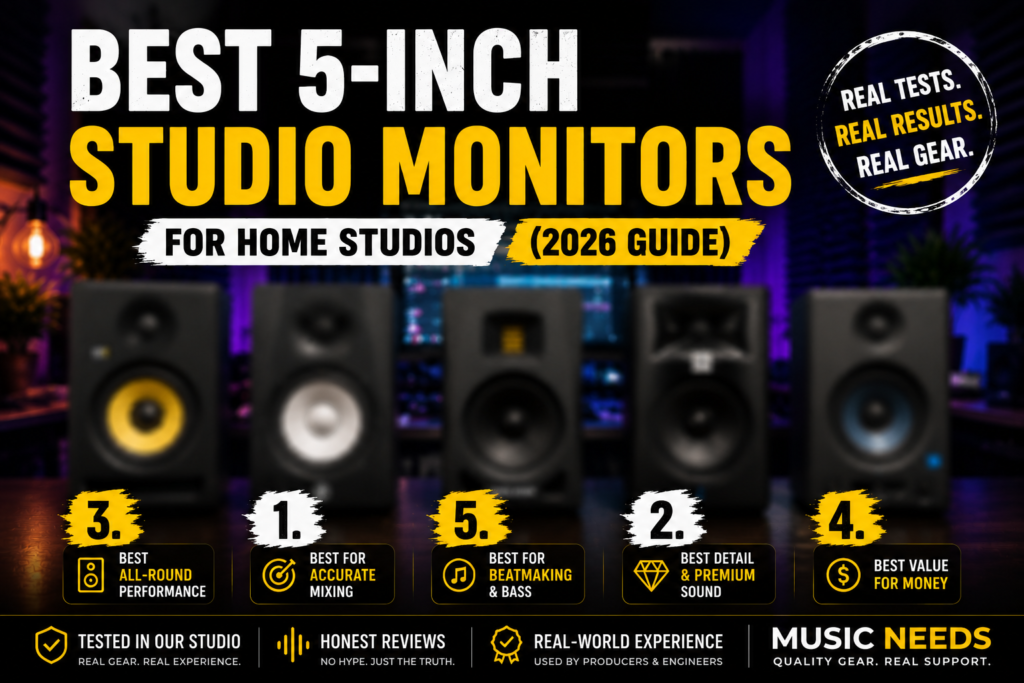
| Rank | Studio Monitor | Best For |
|---|---|---|
| 🥇 1 | Yamaha HS5 | Accurate mixing |
| 🥈 2 | ADAM Audio T5V | Premium detail & clarity |
| 🥉 3 | JBL 305P MKII | Best all-round performance |
| 4 | PreSonus Eris 5 | Beginner home studios |
| 5 | KRK Rokit 5 G4 | Beatmaking & bass-heavy genres |
Which Monitor Is Best for Your Music Style?
Different genres often benefit from different monitor characteristics. Producers making vocal-heavy music may prioritize midrange accuracy, while beatmakers may prefer stronger bass response and energy.
If you mainly mix vocals, podcasts, or acoustic music, the Yamaha HS5 or ADAM T5V will probably serve you best. Their detailed mids and highs make editing easier and help expose issues quickly.
If you create trap, hip hop, amapiano, or EDM, KRK Rokits can feel more inspiring during production. The energetic low-end helps you enjoy the creative process more naturally.
For all-round use, the JBL 305P MKII remains one of the strongest balanced choices. It handles multiple tasks comfortably without leaning too heavily toward either extreme.
Beginners on tighter budgets will likely appreciate the PreSonus Eris 5 because it offers a forgiving and practical entry point into studio monitoring without feeling overwhelming.
Tips for Setting Up Studio Monitors Properly
Even the best monitors can sound disappointing if they’re placed incorrectly. Proper setup matters far more than most beginners realize.
Your speakers should form a triangle with your listening position. The tweeters should sit roughly at ear level, and both monitors should be equally spaced from your position. Small adjustments in placement can completely change stereo imaging and bass response.
Monitor stands or foam isolation pads can also improve clarity by reducing desk vibrations. Many producers underestimate how much their desk affects sound quality.
Room treatment matters too. Even basic acoustic panels behind your monitors and at reflection points can dramatically improve clarity. Untreated rooms often create false bass buildup and harsh reflections that confuse mixing decisions.
Learning your room and speakers takes time. Spend hours listening to professionally mixed songs through your monitors so your ears understand how balanced music should sound on your setup.
Should You Buy Used Studio Monitors?
Buying used studio monitors can actually be one of the smartest ways to build a studio affordably. Many monitors are built to last for years when treated properly.
At Music Needs, we regularly test and sell used or refurbished studio monitors because many still perform extremely well long after purchase.
The biggest advantage is value. Sometimes you can buy higher-end monitors used for the same price as cheaper entry-level monitors brand-new. That allows producers to access better sound quality without destroying their budget.
When buying used monitors, check for:
- Balanced sound between both speakers
- No rattling or distortion
- Working tweeters and woofers
- Physical damage
- Power hum or buzzing
A clean pair of used monitors can easily outperform cheaper new alternatives if tested properly before purchase.
Conclusion
There’s no single perfect studio monitor for everyone. The best choice depends on your room, workflow, music style, budget, and personal taste.
The Yamaha HS5 remains one of the best options for producers who want honest accuracy and mixes that translate everywhere. The ADAM Audio T5V delivers premium detail and clarity that feels far more expensive than its price tag. The JBL 305P MKII offers incredible all-round performance, while the PreSonus Eris 5 gives beginners a practical and affordable starting point. For beatmakers chasing energy and inspiration, the KRK Rokit 5 G4 continues to dominate.
At the end of the day, learning your speakers properly matters more than endlessly upgrading gear. A producer who truly understands their monitors will almost always make better music than someone constantly chasing new equipment.
If you’re looking for used or refurbished studio monitors in South Africa, Music Needs regularly stocks tested and verified studio gear for home studios and creators.
FAQs
1. Are 5-inch studio monitors enough for mixing?
Yes. For most home studios and bedroom setups, 5-inch monitors provide enough detail and bass response for professional-level mixing, especially in smaller rooms.
2. Which 5-inch monitor has the best bass?
The KRK Rokit 5 G4 generally delivers the punchiest bass response among the monitors in this guide.
3. Are Yamaha HS5 monitors good for beginners?
Yes, but they can feel unforgiving at first. Once learned properly, they help beginners develop stronger mixing skills.
4. Should I buy studio monitors or headphones first?
Ideally both, but studio monitors usually provide a more natural stereo image and listening experience for mixing and production.
5. Can I use studio monitors without acoustic treatment?
Yes, but even basic treatment can significantly improve accuracy and overall sound quality.