
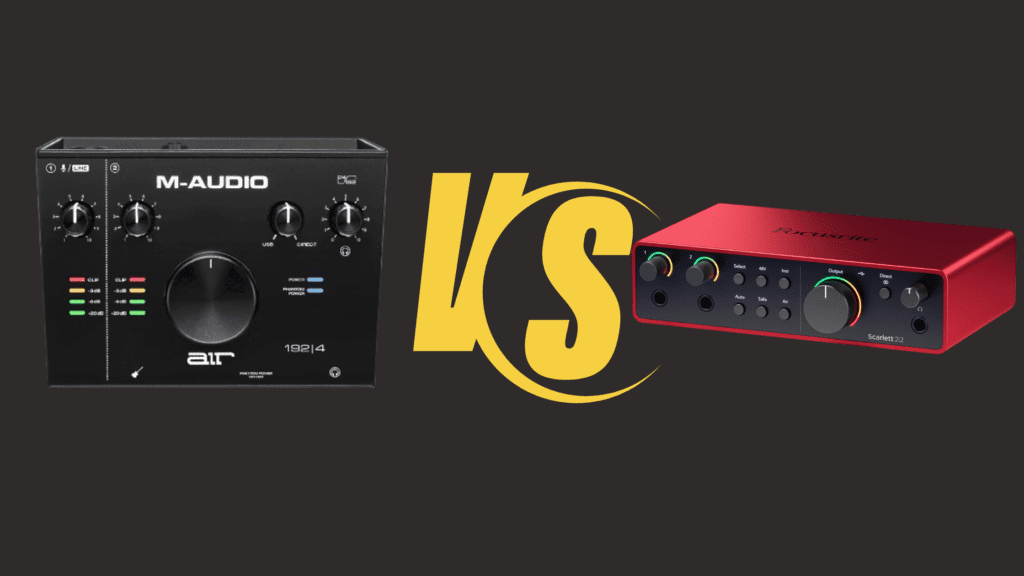
If you’re deciding between the M-Audio AIR 192|4 and the Focusrite Scarlett Solo, you’re probably setting up a home studio for vocals, beats, guitar, podcasting, or general content creation.
Both interfaces sit in the same entry-level category, both are technically capable, and both are widely used.
The difference isn’t about “better vs worse” — it’s about workflow, sound character, and how you record.
Let’s break it down without brand loyalty or hype.
Before We Compare (Important Context)
This comparison is not based on YouTube demos, marketing claims, or fan opinions.
Both interfaces are clean, stable, and capable of professional results when used correctly.
What actually matters here:
- How you work
- What you record most often
- Whether you want simplicity or character
📊 Quick Feature Comparison
| Feature | M-Audio AIR 192|4 | Focusrite Scarlett Solo |
|---|---|---|
| Mic preamps | Crystal™ preamps | Focusrite Scarlett preamps |
| Max sample rate | 24-bit / 192kHz | 24-bit / 192kHz |
| Instrument input | Yes | Yes |
| Air Mode | No | Yes |
| Direct monitoring | Yes | Yes |
| Headphone output | Yes | Yes |
| MIDI I/O | No | No |
| Inputs | 2 | 2 |
| Outputs | 2 | 2 |
| Power | USB | USB |
On paper, they’re very similar.
The differences show up in how they feel and sound in real use.
🎤 Preamps & Sound Character
M-Audio AIR 192|4
- Clean and neutral
- Slightly flatter tonal character
- Minimal coloration
- Predictable results across genres
This makes it easy to shape sound later using plugins, especially for beatmakers and producers who prefer starting from a neutral source.
Focusrite Scarlett Solo
- Slightly more presence in the upper mids
- Air Mode adds a subtle high-frequency lift
- Can help vocals sound more open during recording
Air Mode isn’t “better” — it’s a tonal choice.
Some voices benefit from it, others don’t.
In practice:
- Neutral capture → AIR 192|4
- Slight vocal enhancement at input → Scarlett Solo
⚙️ Features & Workflow
AIR 192|4 Workflow
- Very simple layout
- Large central volume knob
- No extra modes to think about
- Easy for beginners to understand immediately
This interface gets out of the way quickly and is hard to misuse.
Scarlett Solo Workflow
- More traditional studio-style control
- Air Mode adds an optional tonal decision
- Slightly more attention required during setup
Neither workflow is “better” — one is simply more minimal, the other more character-oriented.
🎧 Monitoring & Stability
Both interfaces offer:
- Zero-latency direct monitoring
- Clean headphone outputs
- Reliable USB performance on modern systems
In daily use, the differences here are minor.
Monitoring quality will be influenced far more by:
- Headphones
- Gain staging
- Recording environment
🔌 Inputs & Expandability
Both interfaces are limited to:
- 1 microphone input
- 1 instrument input
- 2 outputs
There is no expansion path on either model.
If you expect to record more than one mic at a time in the future, you’d be looking at:
- Scarlett 2i2 / 4i4
- M-Audio AIR 192|6
For single-mic setups, both are sufficient.
❗ What Neither Interface Will Fix
It’s important to be realistic.
Neither the AIR 192|4 nor the Scarlett Solo will:
- Fix poor mic placement
- Replace room treatment
- Improve a weak performance
- Remove background noise
- Magically make recordings sound “professional”
They are tools — not shortcuts.
🧠 What This Means in Real Use
M-Audio AIR 192|4 makes more sense if:
- You’re a beatmaker or producer
- You want a neutral starting point
- You prefer minimal controls
- You value speed and simplicity
- You don’t want tonal processing at input
Focusrite Scarlett Solo is a better fit if:
- You mainly record vocals or guitar
- You like a bit of character during recording
- You want the option of Air Mode
- You prefer a more traditional interface feel
- You plan to stay within the Scarlett ecosystem
📊 Side-by-Side Summary
| Category | More Suitable Option |
|---|---|
| Simplicity & speed | AIR 192|4 |
| Neutral capture | AIR 192|4 |
| Vocal presence | Scarlett Solo |
| Optional tonal character | Scarlett Solo |
| Beginner home studio | AIR 192|4 |
| Singer / songwriter focus | Scarlett Solo |
🧠 Final Verdict
Both the M-Audio AIR 192|4 and the Focusrite Scarlett Solo are solid entry-level audio interfaces with more similarities than differences.
The AIR 192|4 prioritizes neutral sound and simplicity, making it a strong choice for producers, beatmakers, and beginners who want a clean workflow.
The Scarlett Solo offers a slightly more character-driven input stage, which can suit vocal-focused recording when Air Mode aligns with the source.
If you choose based on how you record, not brand reputation, either interface can serve you well.