
Great — let’s make this a proper educational article (the type that ranks on Google + helps you sell interfaces).
We’ll explain the sound, tech and especially the console preamp heritage (the big consoles) — that’s what makes Audient special.
When people talk about beginner audio interfaces, they usually compare features.
But with Audient, the real story is not the features.
It’s the preamp.
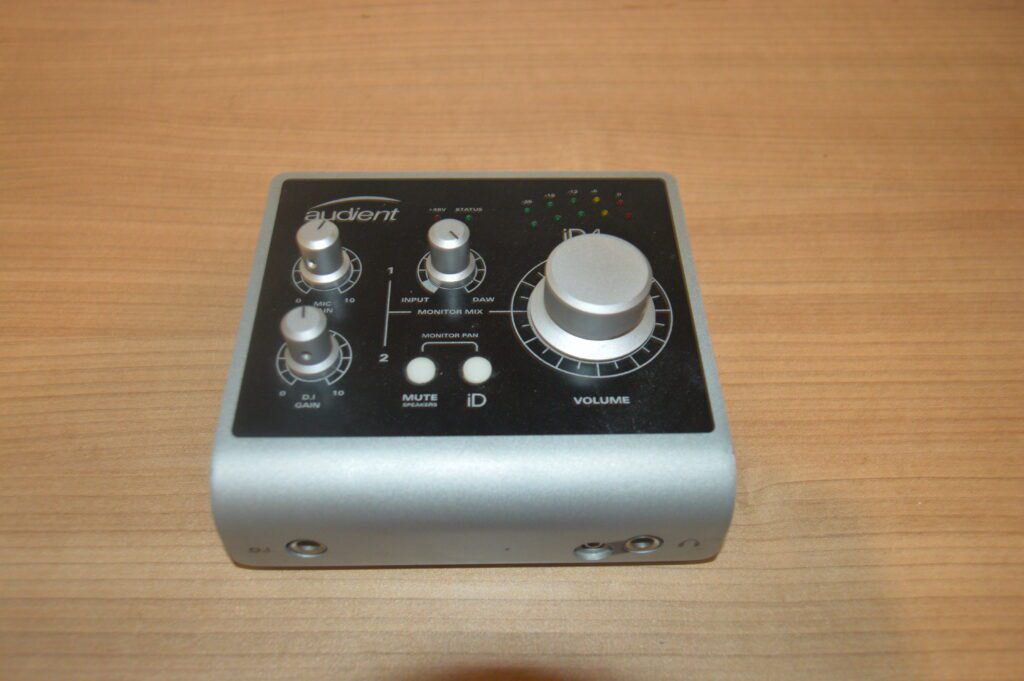
Audient didn’t design the iD4 as a cheap home-studio interface —
they built it using the same mic preamp circuit used in their large format recording consoles.
And that changes everything.
🏢 The Console Heritage (Why Audient Sounds Different)
Audient interfaces use their Console Mic Preamp design taken from their professional recording desks like:
- ASP8024-HE large format console
- ASP4816 studio console
These consoles are used in professional studios worldwide and are known for being:
- very clean
- very low noise
- natural sounding
The preamp design is fully analogue and discrete, created to capture audio accurately rather than color it. (Audient)
So instead of “budget interface sound”,
you get what engineers call real front-end recording quality.
This is why vocals recorded through Audient often need less EQ and less noise reduction.
🔊 Sound Character (The Famous Audient Sound)
Audient sound is usually described as:
Clean + open mids + smooth highs
Not warm like vintage gear
Not bright like Focusrite
Not colored like SSL
Just accurate.
That makes it especially good for:
- rap vocals
- singing
- voice-overs
- acoustic instruments
⚙️ Main Differences — MK1 vs MK2
Connection & Speed
MK1
- USB 2.0
- Older connection standard
MK2
- USB-C
- Much faster data transfer
- Lower latency recording (Musiekwêreld)
👉 This mainly affects monitoring delay and stability.
Converter Quality (Important)
The MK2 improved the converters significantly:
- Better dynamic range on input
- Cleaner playback on output (Musiekwêreld)
This means:
Less hiss
More detail
Better headphone clarity
Noise Performance
MK1 was already clean.
MK2 is quieter — especially noticeable on:
- dynamic microphones
- gain-heavy mics (like SM7B)
Build & Power
MK1
- Micro-USB
- More sensitive to weak USB ports
MK2
- USB-C bus powered
- Works better with laptops and phones (Musiekwêreld)
🎙️ Real Recording Difference
The preamp itself is similar in tone.
But the MK2:
- handles gain better
- clips less easily
- sounds clearer at loud levels
So recordings feel more “finished” straight away.
📊 Quick Comparison Table
| Feature | iD4 MK1 | iD4 MK2 |
|---|---|---|
| Preamp Design | Console preamp | Same console preamp |
| Connection | USB 2.0 | USB-C |
| Latency | Higher | Lower |
| Converters | Good | Improved clarity |
| Noise Floor | Clean | Cleaner |
| Stability | Normal | More stable |
| Mobile Use | Limited | Much better |
🧠 Which One Should You Buy?
Buy MK1 if:
- Very cheap second-hand price
- Simple home recording
- Not using heavy gain microphones
Buy MK2 if:
- Using SM7B / dynamic mics
- Recording vocals seriously
- Want long-term interface
- Using laptop / USB-C devices
⭐ Final Verdict
Both interfaces sound professional because the preamp comes from real studio consoles.
But the MK2 fixes the weaknesses of the MK1.
The upgrade is not about tone —
it’s about clarity, stability and cleaner recording workflow.
MK1 = still good
MK2 = modern & reliable
If you want, next I can also create a “vs Focusrite 2i2” article — that one attracts A LOT of traffic 😄